
Research · The News Front Data Desk
The start-up class of 2026: 466,727 new UK companies, and nearly one in five is a shop or food business
Key findings
- 466,727 companies were incorporated in the UK between January and September 2026 and were still live at 30 September, after setting aside 4,736 with a missing or unrecognised postcode and removing 121,280 registered at 131 mass-registration addresses.
- Nearly one in five new companies (89,114) is a retailer (53,424) or food & drink business (35,690), and almost half of the new retailers (25,970) are online or mail-order shops.
- London has 148.0 new companies per 10,000 adults, about three times Northern Ireland's rate of 47.2; the UK rate is 84.1.
- With agent addresses removed, Redbridge (218.8 per 10,000 adults), Harrow (203.4), Slough (178.6), Barnet (173.9) and Luton (170.0) are the UK's busiest start-up areas.
- 78.2% of the UK's 2.79 million VAT- or PAYE-registered businesses employ fewer than five people.
More than 466,000 new companies have joined the UK register so far this year. Nearly one in five of them will be selling to shoppers or feeding them, just as the busiest trading weeks of the year begin.
The News Front Data Desk analysed every company incorporated between 1 January and 30 September 2026 that was still live on the Companies House register at 30 September. In all, 592,743 companies were registered in those nine months. That is about 2,170 a day. Companies House’s own official statistics, published on 29 October, give a near-identical total of 590,688 incorporations over the same nine months (204,612 from January to March, 192,287 from April to June and 193,789 from July to September). They also show the register shrinking by 30,383 companies between July and September, because 226,091 companies were struck off as the new ones arrived.
Headline counts like this include a large number of companies that exist only at a formation agent’s or virtual-office address, a single postcode that can host thousands of firms. We removed every postcode with 100 or more new companies this year: 131 addresses, accounting for 121,280 registrations. The largest single address, in London’s West End, was home to 24,898 new companies. A further 4,736 companies had a missing or unrecognised postcode and could not be placed in an area. The cleaned total is 466,727 companies, about 1,710 a day, and it is the basis for everything below.
A shopkeepers’ and cooks’ class
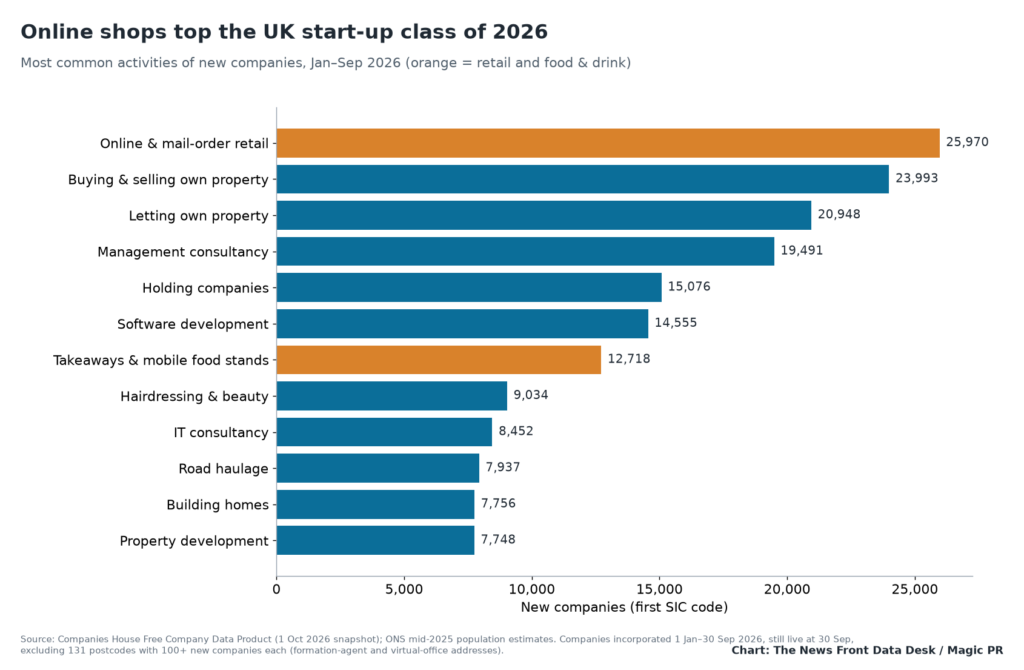
The most common single activity among 2026’s new companies is online or mail-order retail, with 25,970 companies, ahead of buying and selling property (23,993), letting property (20,948) and management consultancy (19,491). Across all retail, 53,424 new companies list a shop or online store as their main activity, and almost half of those are online or mail-order.
Another 35,690 are food & drink businesses. Takeaways and mobile food stands are the largest group (12,718), followed by unlicensed cafés and restaurants (7,355), licensed restaurants (6,302) and pubs and bars (3,829). Hairdressing and beauty adds 9,034 more consumer-facing firms.
Together, that is 89,114 retail and hospitality start-ups. Most will face their first Black Friday on 27 November and their first Small Business Saturday on 5 December. They are joining a business population that is already overwhelmingly small: according to the Office for National Statistics, 78.2% of the UK’s 2.79 million VAT- or PAYE-registered businesses employ fewer than five people.
London leads, but not where you might think
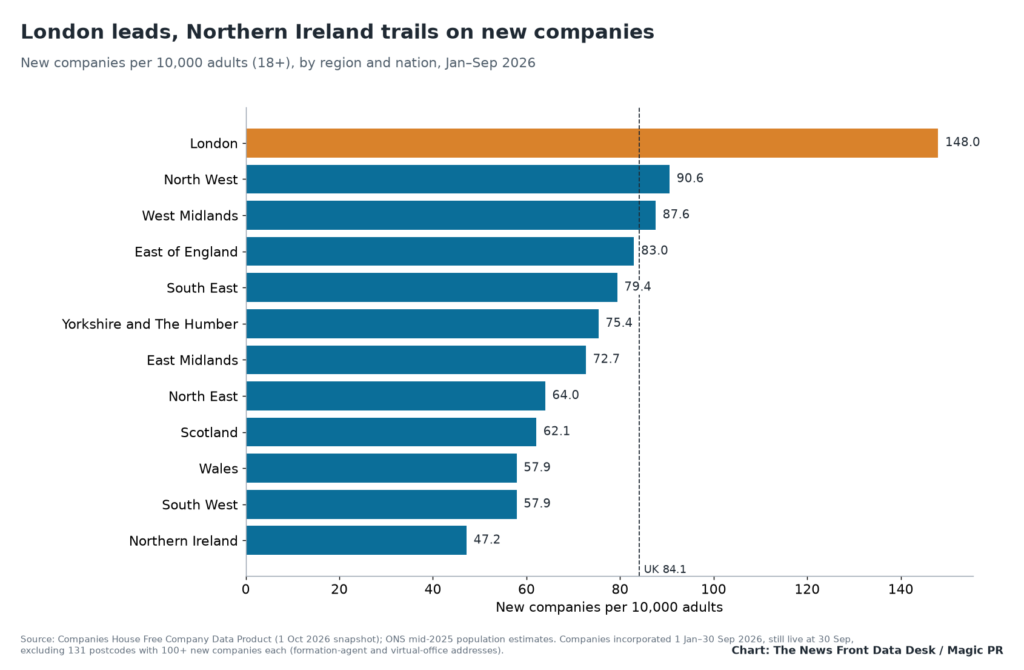
To compare places fairly, we measured new companies per 10,000 adults. London leads with 148.0, ahead of the North West (90.6) and the West Midlands (87.6). The UK average is 84.1. Northern Ireland has the lowest rate (47.2), followed by Wales and the South West (both 57.9) and Scotland (62.1). Adjusted for population, Londoners set up companies at about three times the rate of people in Northern Ireland.
Uncleaned league tables usually put Camden or Westminster at the top. Our analysis suggests that mostly reflects where companies are registered rather than where they trade: 89% of Camden’s 32,310 new registrations this year were at mass-registration addresses. We have therefore left 39 councils whose figures depend heavily on such addresses, or whose populations are very small, out of the rankings.
Among the remaining 322 councils, the busiest start-up areas are in outer London and just beyond it. Redbridge has 218.8 new companies per 10,000 adults, followed by Harrow (203.4), Slough (178.6), Barnet (173.9) and Luton (170.0). Birmingham has the most new companies of any council outside London (12,543), a rate of 140.3. Redbridge also has the highest combined rate of new retail and food & drink firms (53.9 per 10,000 adults).
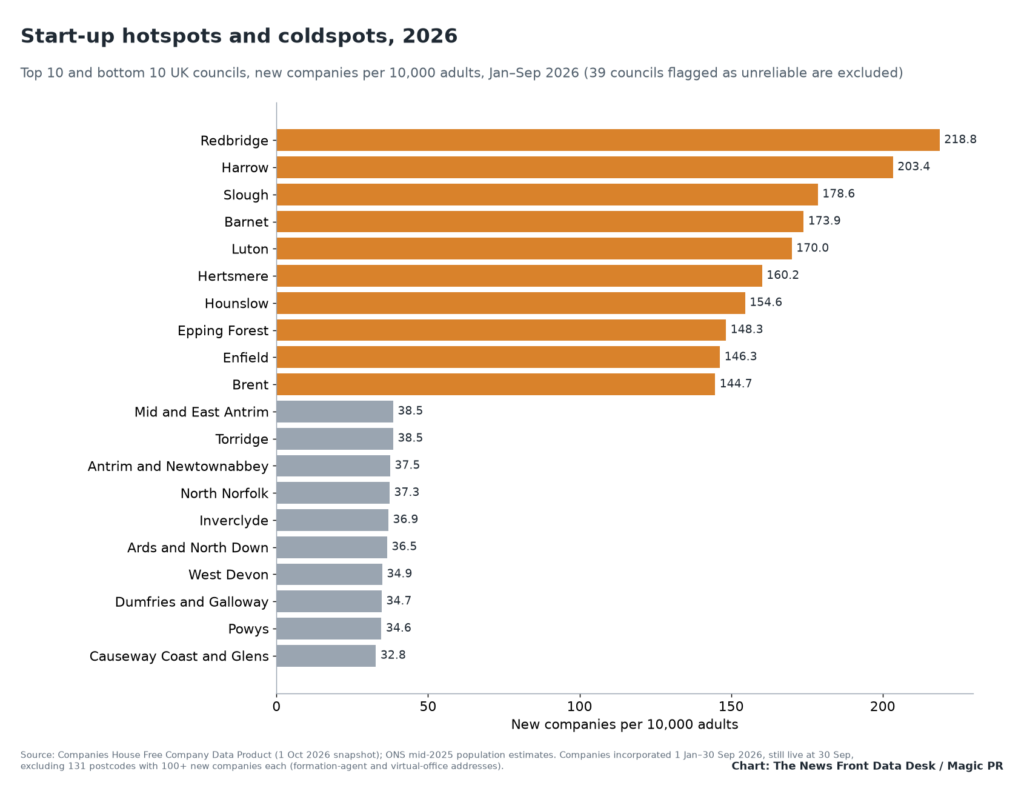
The quietest areas are largely rural. Causeway Coast and Glens (32.8 per 10,000 adults), Powys (34.6), Dumfries and Galloway (34.7), West Devon (34.9) and Ards and North Down (36.5) have the lowest rates. The median ranked council has 65.7.
What it means for small firms
Registering a company is not the same as trading. Some of these companies will never sell anything, and many sole traders never incorporate at all. Even so, the 2026 class shows where enterprise is concentrated, and that a large share of it is small, local and consumer-facing.
“Companies House’s own figures show more companies were struck off than formed between July and September, so the people starting out this year are doing it the hard way. Nearly 90,000 of this year’s new firms are shops, cafés and takeaways heading into their first Christmas, and Small Business Saturday on 5 December is a real chance for them to be seen. The places with the most new businesses are not always the ones you’d expect, and that matters for anyone trying to support them.”
M. Hussain, founder of Magic PR
We have not compared these figures with 2025. Our source only includes companies that are still live, and companies registered last year have had longer to close, so a like-for-like comparison would overstate any rise. Companies House’s official quarterly statistics remain the reference for national totals over time. The next official release is due on 28 January 2027.
Method and caveats
We took every company in the Companies House Free Company Data Product (snapshot dated 1 October 2026; live companies only) with an incorporation date from 1 January to 30 September 2026. Each company was placed in a council area and region using the postcode of its registered office and the ONS National Statistics Postcode Lookup (August 2026); 4,736 companies with a missing or unrecognised postcode could not be placed and are excluded. Any postcode with 100 or more new companies in the period was treated as a formation-agent or virtual-office address and excluded (131 postcodes, 121,280 companies). The totals change by between −3.5% and +1.9% at thresholds of 50 and 200, and the hotspot and coldspot rankings barely change. Sector is the first SIC code given at registration: retail = SIC division 47; food & drink = SIC division 56. Rates use ONS mid-2025 estimates of adults aged 18 and over. 39 councils are flagged as less reliable (central London registration hubs, heavy agent-address use, or fewer than 20,000 adults) and are not ranked. The micro-business share is the 0–4 employee band in ONS UK Business: Activity, Size and Location 2026, Table 10. Our raw total of 592,743 is within 0.4% of the 590,688 incorporations in Companies House’s official statistics for the same period (https://www.gov.uk/government/statistics/incorporated-companies-in-the-uk-july-to-september-2026/incorporated-companies-in-the-uk-july-to-september-2026). The full council-level dataset is available to download.
Caveats
- Covers live companies only. Companies incorporated and then dissolved before 30 September 2026 are not counted.
- A registered office address is not necessarily where a company trades.
- Sole traders and partnerships are not companies and are not included.
- No fair comparison with 2025 is possible from this source (survivorship), so none is made.
- Sector is self-declared at registration (first SIC code only).
- Our counts are not the official Companies House incorporation statistics.
Data: Companies House (credit Companies House). Contains ONS data licensed under the Open Government Licence v3.0, © Crown copyright 2026. Our dataset and charts are released under CC BY 4.0 with credit to “The News Front Data Desk”.
Data sources
- Companies House, Free Company Data Product (1 October 2026), checked against Companies House's official statistics, Incorporated companies in the UK, January to September 2026
- Office for National Statistics, UK Business: Activity, Size and Location 2026
- ONS mid-2025 population estimates (via Nomis) and ONS National Statistics Postcode Lookup, August 2026
Data licence: CC BY 4.0. Please credit ‘The News Front Data Desk’.
This study was funded by Magic PR. The News Front Data Desk designed the method, ran the analysis and had full editorial control of the findings. Read our disclosure.